Florida is in the middle of deciding how artificial intelligence gets handled in its classrooms, and St. Johns County is ahead of the state on it.
The State Board of Education has been weighing a rule change that would require public and charter schools to address artificial intelligence within their internet safety guidelines, taking the proposal up at a workshop on August 5. Several Northeast Florida districts did not wait.
St. Johns County School District and Clay County District Schools have both published guidance covering student and teacher use of generative AI, and Duval County moved to revise its student code of conduct around AI and academic dishonesty.
The timing is useful, because the research that should inform those rules has become a good deal sharper in the past year.
The experiment that isolated what actually matters
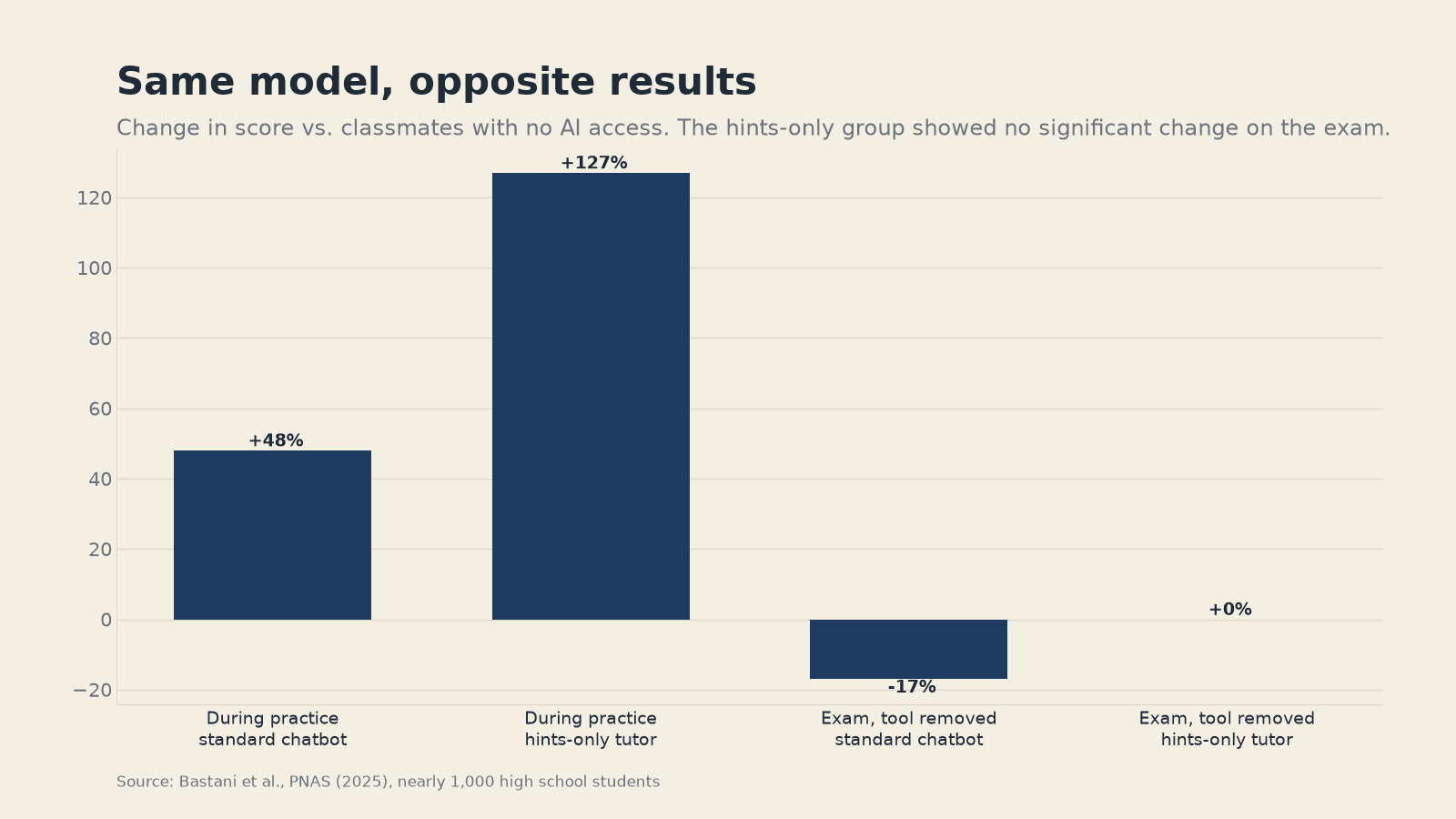
Researchers gave roughly a thousand high school students access to GPT-4 during mathematics practice. With the tool, practice scores rose 48 percent over students working without it.
Then they took it away and gave an exam. The students who had used the chatbot scored 17 percent worse than classmates who never had access to it.
The study, in the Proceedings of the National Academy of Sciences, found students had been using the model as a crutch. The important part is what that looked like from the outside: practice work improved, homework improved, engagement improved. The loss showed up only when the tool was gone. A school tracking completion and grades would have recorded a good year.
The version that did no harm
A third group used the same GPT-4 model with one modification. It was instructed to give incremental hints and never the full answer.
They gained the most during practice, 127 percent, and showed no significant deficit on the exam. Identical technology, opposite outcome, decided entirely by how the tool had been told to behave.
The privacy question Florida is actually asking
Notably, the state's proposed rule approaches AI through internet safety rather than through academic integrity, and researchers in Florida have argued that is the right frame.
Dr. Vanessa Dennen, a professor and researcher at Florida State University, has raised the data trail these tools leave on both sides of the desk. On teachers using AI to help with grading, she asked whether student names end up uploaded along with the papers.
On students, she noted they "can be putting in little pieces of information, and over time they've given away a lot of information about their identity."
Her view of the state's involvement was favorable. "I think it's really great that the state is pushing this conversation to happen," she told Action News Jax.
Enforcement is the weakest link
Any rule that leans on catching students runs into a documented problem.
Stanford researchers tested widely used AI detectors against essays written by human non-native English speakers and found the tools consistently misclassified that writing as machine generated. More than half of the non-native essays were flagged, while the same detectors were nearly perfect on writing by native speaking US eighth graders. The detectors were reading plainer sentence construction as evidence of a chatbot.
Vanderbilt disabled Turnitin's AI detector in August 2023 over its reliability, false positives and disparate impact on international students, and other universities have followed. Whatever the right policy is, detection is not a foundation to build it on.
What teachers report
Gallup and the Walton Family Foundation found about six in ten teachers used AI in the past school year and roughly a third use it weekly, with weekly users saving an average of 5.9 hours a week, close to six weeks across a year.
Only 18 percent had received any formal guidance from administrators, and about a third had received none. That gap is precisely what district level guidance of the kind St. Johns County has published is meant to close.
The strongest evidence on the other side
A World Bank randomized trial in Benin City, Nigeria, ran first year senior secondary students through six weeks of teacher supervised after school English sessions using Microsoft Copilot. The result was 0.31 standard deviations on the full assessment, which covered English, AI knowledge and digital skills, and 0.23 on English alone, the study's main outcome.
The researchers report the program outperformed 80 percent of the interventions in a comparison database of randomized trials in developing countries.
The design was structured and teacher supervised, closer to the hint giving configuration than to a student alone with a chatbot. Gains were uneven, and the study found the largest effects among female students and among those with higher initial academic performance, which suggests these tools can raise averages and widen gaps simultaneously.
Where the evidence stops
The Turkish trial is four sessions, one subject, one country, roughly 15 percent of the semester's curriculum. Mathematics happens to be the friendliest possible case for a hint based tutor: the answers are definite and the common mistakes are already documented. Writing and history are untested.
Nothing here measures more than a few weeks, so whether the deficit lasts is unknown.
And none of it explains declining test scores. Those declines set in among the lowest performing students after 2012, years before ChatGPT existed. Blaming AI for them does not fit the dates.
The question to bring to a teacher
The evidence does not point toward prohibition, and it does not point toward handing a child a chatbot and hoping. It points at one question, which any parent can ask at a conference:
When my child is stuck, does this tool give the answer, or the next hint?
That difference was worth everything in the only controlled test that exists. As Florida finalizes what districts must address, it is also the difference most likely to matter more than any wording in a policy.
Sources
- Bastani, H., Bastani, O., Sungu, A., Ge, H., Kabakci, O. and Mariman, R. "Generative AI without guardrails can harm learning: Evidence from high school mathematics." Proceedings of the National Academy of Sciences, 2025.
- Gallup and the Walton Family Foundation, teacher AI surveys, 2025.
- AcadeResearch, "Practice Up 48%, Exams Down 17%: Does AI Stop Children From Learning?", August 2026.
- Action News Jax, "Florida could require schools to set rules for AI use," July 2026.
- Liang, W. et al. "GPT detectors are biased against non-native English writers." Patterns, 2023.
- World Bank Education Global Department, "From Chalkboards to Chatbots," Nigeria.